Thursday, November 25, 2021

QUARANTINE BLOG # 605

November 25, 2021

Walter A. Maier held a doctorate in philosophy from Harvard and taught at Concordia Seminary in St. Louis, but is best known for his worldwide radio broadcast, “Bringing Christ To the Nations.” He was heard in over 120 nations. Billy Graham called him the greatest evangelist of the 20th century. 

The following, “Thank God Even in Darkened Days!” is a message he preached during World War II.  I have condensed it for today’s blog.  If you would like to read the entire powerful message, click here.

And now, Maier’s Thanksgiving message.

Back in November, 1930, when unemployment was high, farm prices low, bread lines long, shelters for the homeless full, the American Association for the Advancement of Atheism sent a petition to the President asking that the annual Thanksgiving proclamation be omitted. How, these deniers of truth argued, can anyone give thanks with so much suffering and want throughout the land? How can people praise a God who permits such widespread anguish?

Today, from coast to coast Thanksgiving orators have called attention to America’s unparalleled blessing even in war time. Ours is the greatest country in the world. We have immeasurable natural resources hidden in treasure houses beneath our soil, spreading in almost unlimited extent over its surface in forests, fertile farmlands, bounteous orchards. While diseases ravaged large areas in Europe, this country has escaped serious epidemics. Millions in China and Greece hover on the very edge of starvation; yet the past year, despite restriction and rationing, has not deprived our people of necessary and wholesome food. We have had bounteous harvests.

Even in war’s afflictions, God has been good to us. No enemy troops have landed on our shores. No enemy planes have bombed our cities. No enemy invasion has even threatened our borders. We have blackouts, but only for practice.

Add to these material blessings the liberties that are ours. We have a democratic government, while other peoples are crushed beneath the heel of tyranny. Freedom of thought, freedom of expression, freedom of education all these are still ours while other nations are regimented by destructive dictatorships. Above all, we still have religious freedom, the personal privilege of worshiping the Almighty according to His Word without state direction. 

Yet despite these reasons for gratitude, many are seized with bitterness because of financial reverses, family losses, personal afflictions. Now, I would speak to you, the lonely, distressed, spiritually shaken, destitute, bereaved but also to you, the satisfied, secure, socially prominent, financially firm with larger incomes than you have ever before received and the heaviest prosperity you have ever enjoyed. To all of you I say in the name of Jesus Christ: Take as your example heroic Daniel, of whom it is written in our text, “He kneeled upon his knees three times a day and prayed and gave thanks before his God” (Daniel 6:10).

Daniel was in exile in Babylon, far from his beloved Judah and Jerusalem, a stranger in a strange, hostile nation. Many personal enemies surrounded him. The verses preceding our text declare, “all the presidents of the kingdom, the governors, and the princes, the counselors, and the captains . . . sought to find occasion against Daniel”

Daniel’s heaviest burden was imposed by Darius’ decree, demanding that all people in his realm pray to him, the king. This meant that, if Daniel continued to kneel before the true God, he would be thrown to hungry lions. His enemies stealthily watched his house, found him on his knees worshiping God, accused him at the royal court, and insisted that Darius sentence him to death. 

Unwillingly the monarch obeyed, and before the day closed, Daniel was cast into the lions’ den. Yet, instead of being torn to pieces by the bloodthirsty beasts, he was miraculously protected. The Lord’s servant was rescued and returned to his position. His deliverance provoked another decree, directing men throughout the kingdom to bow before Jehovah, since, as King Darius declared, “He is the living God and steadfast forever.” What a glorious Thanksgiving Day that was for Daniel!

What a blessed Thanksgiving Day this can be for you if with all your heart you follow Daniel by turning to the Almighty in Christ and thank Him for His marvelous mercies! No matter how hard the past has been, how uncertain the future, if you have accepted the Lord Jesus as your Savior, the twenty-four hours of Thanksgiving Day will not be long enough to express your gratitude for His mercy in redeeming you from sin and its sentence of eternal death. 

Can you say and believe sincerely, “Jesus died for me”? Then thank God without ceasing for the greatest gift even His love can give you this assurance of your salvation! 

Do you own a Bible, the errorless Word of redemption, “which is able to build you up”? Thank God for this sacred truth which can direct you safely in every dark hour, along each uncharted path! 

Even if you have been guilty of many and serious sins, read the promises of Sacred Scripture to learn, “Though your sins be as scarlet, they shall be white as snow; though they be red like crimson, they shall be as wool” all through the complete, assured grace of the Savior who gave Himself for you! 

Are you tempted to refuse thanking God since your happiness has been small? When the Plymouth Pilgrims observed their first Thanksgiving, they had harvested the yield of only twenty acres of corn, six acres of barley and peas. Their world was but a few square miles surrounded by the perils of pathless wilderness, yet they set aside a special day to praise their Lord. How much more you have for which to sing your gratitude to the heavenly Father! Count your blessings, one by one, and believe that the almighty Creator and Sustainer, with whom “nothing shall be impossible” can, if it be for your eternal good, multiply your earthly benedictions overnight.

The other day I read of a shipwrecked man who managed to reach an uninhabited island. There, to protect himself against the elements and to safeguard the few possessions he had salvaged, he painstakingly built a little hut from which he constantly and prayerfully scanned the horizon for the approach of a ship. Returning one evening after a search for food, he was terrified to find the hut completely enveloped in flames. What a crushing disaster that seemed! Yet by divine mercy this hard affliction was changed into a mighty advantage. Early on the following morning he awoke to find a ship anchored off the island. The captain stepped ashore and explained, “We saw your smoke signal and came.” What the man saw as total disaster was the means to his rescue.

We read of Saint Paul that in one of his many difficulties “he thanked God, and took courage.” May you, my fellow redeemed, on this wartime Thanksgiving praise God for the Savior and take courage in Christ for whatever may confront you! In true courage stand beneath the cross and, with your arm raised in the oath of allegiance to the crucified Redeemer, cry out, “Thanks be to God, which giveth us the victory through our Lord Jesus Christ!’ The Lord grant you that supreme Thanksgiving joy for the Savior’s sake! Amen.

-30-

Wednesday, November 24, 2021

QUARANTINE BLOG # 604

November 24, 2021

We begin today with the story of birds.  Two stories, actually.  The first one involves your favorite blogger.

Yesterday morning I was sitting at the kitchen table, eating two hard boiled eggs for breakfast, drinking my second cup of coffee and reading the latest adventures of Guido Brunetti – Bonnie had gone to Sam’s for supplies for Thanksgiving Dinner – when something dropped onto the floor beside of me.  Out of the corner of my eye I could see something brown, and thought it was a leaf from one of the plants which decorate the kitchen.  It was not.  It was a small brown bird.

Said bird, when I looked at him (or her – who can tell with small brown birds) hopped onto the window sill, then flew behind the curtain, then out onto the air fryer, and then flew into the computer room where he sat on top of the official TV-VCR combination of MIR Children’s Foundation (a story for another time).  From there, he flew onto the ceiling fan, then into the dining room and went under the table.  Next on top of the cabinet with the Russia souvenirs.  And around and around. 

I spent the next 20 minutes chasing my uninvited guest – Google suggests that the visitor was a house wren – with a towel.  I tried to drop it over him, but he was always faster.  And clever in his hiding places.  Finally, I opened the door and 10 minutes later my uninvited guest flew out the same way he got in.

When Bonnie got back from Sam’s, and I was telling her the story, blaming our children – some of whom, and their children, habitually leave the front door open just to hear me growl, “I’m not paying to heat the whole neighborhood!”  She said, “I went over to the storage building and I didn’t close the front door the whole way.  I pushed it up to the frame, but it wasn’t completely closed.”

But she brought me a caramel macchiato from Starbucks, so she is forgiven.

👉  In 1965 Paul Harvey did a story about birds that he broadcast at Christmas time, but in light of the above story, I share it today.  Paul Harvey called it, “The Man and the Birds.”


👉  A couple of signs for the times:


👉  One “Blackout” and one “Ooh You’re Gold”:


👉  It’s either a walk down memory lane or a history lesson – here are some more vintage photographs:

TV Dinners Were A Huge Hit

Although today, eating TV dinners may not “be in,” that certainly wasn’t the case back in the 1950s. Back then, they were all the rage. The term “TV Dinner” was first used as part of a brand of packaged meals developed in 1953 by C.A. Swanson & Sons, with its full name being TV Brand Frozen Dinner. Most TV dinners came in an aluminum tray that was then heated up in the oven (microwave ovens weren’t readily available until the mid-60s).

Fallout Shelters Were A Legitimate Concern

The 1950s was a time of heightened fear of the Soviet Union and the use nuclear bombs.  Fear of atomic war caused families to begin creating fallout shelters.  These fallout shelters even began to be advertised and turned into an actual consumer product.  The government had even announced that it would be the best way for families in suburban areas to survive in the case of an attack.

I remember asking Dad if he would build one in the backyard of 117 Shenandoah Avenue.  His answer had two parts and it put to rest forever the idea of building a bomb shelter.  First, Loch Lynn, Maryland would never be on Russia’s target for an atomic bomb.  Second, if a bomb did drop on us and we survived in the shelter, with radiation all around, what would we do when we came out from our underground hiding place?

👉  Amy sent me some new funnies that will appear under the category “Think About It.”


👉  And in anticipation of tomorrow’s celebration, one from Baby Blues:

👉  Today’s close, “Giving Thanks All Around,” is by Chuck Swindoll.

“Be thankful in all circumstances, for this is God’s will for you who belong to Christ Jesus” (1 Thessalonians 5:18). 

It’s almost Thanksgiving ... my favorite. I prefer it because it is so healthy, so encouraging, so valuable, and so understated. I prefer it because there are no jingles to sing, commercials to endure, gifts to buy, places to go, or meetings to attend – just be thankful. Just look up, look around, look within, and say, “Thank you, Lord.”

So let’s start early with our Thanksgiving this year.

Looking up. Thank You, Lord: for Your sovereign control over our circumstances, for Your gentle compassion in our sorrows, for Your consistent faithfulness through our highs and lows, for Your grace that removes our guilt, for Your love that holds us close.

Thank You, Lord, for all You are, all You do, all You say. If we were unable to look up into Your face, Thanksgiving would be just another day.

Looking around. Thank You, Lord: for our close family ties, so affirming, so enjoyable; for our marvelous church, so many gifted and loving servants; for our strong heritage, so wholesome, so wise; for the joy of seeing our children grow and learn; for an occupation that enables us to make a living; for the embrace of a friend who really cares.

Thank You, Lord, for all You provide in such variety and incredible abundance. By just looking around, we are made aware of how rich we are this Thanksgiving.

Looking within. Thank You, Lord: for eyes that see the beauty of Your creation, for ears that receive the world of sounds surrounding us, for the special stimulation of taste and touch, for hands to work with and legs to walk with, for a sense of humor that brought healing and hope, for the sheer delight of knowing and walking with You!

Thanksgiving is my favorite. Now you see why.

-30-

Tuesday, November 23, 2021

QUARANTINE BLOG # 603

November 23, 2021

We begin today with some “Ponderables:”


When people see a cat’s litter box they always say, “Oh, have you got a cat?” I just say, “No, it’s for company!”


Employment application blanks always ask who is to be called in case of an emergency. I think you should write, “An ambulance.”


The sole purpose of a child’s middle name is so he knows when he’s really in trouble.


Did you ever notice that when you put the 2 words “The” and “IRS” together it spells “Theirs”?


👉  Calvin and Hobbes address some scary science fiction:

👉  Writing in The Body: A Guide For Occupants, Bill Bryson talks about increasing life expectancy:

“Any number of reasons have been proposed for the improvement ... [a] huge boost can be attributed to vaccines. In 1921, America had about 200,000 cases of diphtheria; by the early 1980s, with vaccination, that had fallen to just 3. In roughly the same period, whooping cough and measles infections fell from about 1.1 million cases a year to just 1,500. Before vaccines, 20,000 Americans a year got polio. By the 1980s, that had dropped to 7 a year. According to the British Nobel laureate Max Perutz, vaccinations might have saved more lives in the twentieth century even than antibiotics.”

The Body was published in 2019, before the pandemic started by the Chinese virus changed the way we live, killing 5.1 million of us, and the anti-vaxxers scream for their right to die or to infect the rest of us.

👉  One from “Ooh You’re Gold”:

👉  Two from Non Sequitor:


👉  Armando Markaj, 27, is a waiter at Patsy’s Pizzeria in Harlem, New York.  One of the tables, on what would turn out to be a very interesting day, was assigned to was an ill-tempered woman and her daughter.  They ordered two slices of New York-style pizza, but, as Armando was just about to walk away back to the counter to send the orders to the kitchen, the older woman stopped him.  “Why are there so few pictures of women on the wall?” the lady asked.  She asked it with malice and with what seemed like an intent to spark outrage and debate.  Armando didn’t have an answer, but he tried a joke, “Maybe women don’t eat a lot of pizza.”  The joke fell flat.

When the women had finished their pizza, he handed them their check, and moved promptly to another table to take their order.  However, upon finishing up on getting the orders, he noticed that the two women had already left.  He was thinking the worst, that the women left without paying their bill.  Another waiter had handled the check-out, and on the slip was written, “Maybe women don’t tip either.”

As he cleared the table, Armando noticed that there was a white envelope under one of the napkins.  When he saw the “Citibank” logo, he run out the door to chase the women down to give the envelope back, but they were gone.  Back inside, he opened the envelope and discovered a cashier’s check – which could be cashed by anyone – for $423,987.55.  As the story developed, Armando gave the check to the Pizzeria’s owner for safe keeping, who then called a newspaper to get help locating Karen Vincor, to whom the check was made out.  She had sold her apartment and put the proceeds and all of her savings into the check to have as a down payment on a new apartment.

The newspaper located Karen and she returned to Patsy’s.  Ashamed for her earlier behavior, she offered Armando a finder’s fee with a heartfelt apology for how she treated him.   Armando accepted the woman’s apology but said no to the money.  “I’m really for her, really,” he told interviewers.  “Saturdays are pretty busy and I was very close to taking everything left on the table and throwing it out when I saw the envelope.”  The two of them settled their differences over a freshly made pizza.

👉  Yesterday I was reading 1 Peter 1, where the apostle speaks of the Lord Jesus, “whom having not seen, you love; in whom, though now you see Him not, yet believing, ye rejoice with joy unspeakable and full of glory.”  And I started singing an old hymn by Frances Ridley Havergal, “Joy Unspeakable and Full of Glory.”  Miss Havergal authored such well known hymns as “I Gave My Life For Thee” and “Take My Life And Let It Be.”  The tune was composed by Ralph Erskine Hudson.  The song was first published in Hudson’s 1893 Glad Tidings.  Hudson is perhaps best known for the melody and chorus “At the Cross” to which we sing Isaac Watts’s hymn beginning “Alas, and did my Savior bleed.”

This video starts out in an almost stately manner, like the way it might be sung in a stately uptown church, but at marker 2:19 they sing it like we did at the Williamsport, Maryland Church of God.  Enjoy.

-30-

Monday, November 22, 2021

QUARANTINE BLOG # 602

November 22, 2021

Today’s sermon, from the Crawfordville Pulpit is “Come Ye Thankful People, Come!”  The Bible reading is Luke 17:11-19.

👉  President John Fitzgerald Kennedy was assassinated in Dallas, Texas, by Lee Harvey Oswald, 58 years ago today.  President Kennedy was 46 years old.


👉  Saturday, Google which ignored September 11, the day terrorists killed 3,000 of us, doodled Edmond Dédé, an American musician and composer from New Orleans, who moved to Europe to study in Paris in 1855, settled in France, and died in 1901.

In case you were wondering, Google has no salute today to the slain president.  It’s blank.  No doodle at all.

👉  If you were driving on Interstate 5 in Carlsbad, California on Friday, you might have thought you’d found the pot of gold, or green, at the end of the rainbow.  Shortly before 9:15 a.m., drivers were scrambling to grab cash as bags of money fell out of an armored truck.  “One of the doors popped open and bags of cash fell out,” California Highway Patrol Sgt. Curtis Martin said.  Several bags broke open, spreading money all over the lanes and bringing the freeway to a chaotic halt.  Video posted online showed some people laughing and leaping as they held wads of cash.  Two people were arrested at the scene, and Martin warned that any others who are found to have taken the money could face criminal charges. He noted there was plenty of video taken by bystanders at the scene and that the CHP and FBI were investigating.

Well, here is a video I made editing a local CBS breaking news story and adding my own sound track.  One woman is seen gathering up some money and then walking furtively away.  And then she is seen wearing CHP bracelets.  Moral of this story: if someone is pointing their cell phone at you, don’t pick up the money!  Better yet, you know it’s not yours – don’t pick it up period.

👉  Reading that some folks did take money into the CHP headquarters reminded me of a story I heard some 40 years.  Raise your hand if I’ve told you this before.

One Friday morning while I was serving as the “editorial assistant to the editor in chief of Church of God Publications” (and all of that was on my letterhead) the president of Lee College – now Lee University – spoke at chapel at the publishing house.

In those days Lee had a 12 inch rule.  Couples – and those were always one male and one female – were required to walk 12 inches apart, no touching.  Dates had to be chaperoned.  They were serious about morality.  Well, one day as the president was walking to his office he noticed a couple in violation of the rule.  Not only were they not 12 inches apart, they shared a quick kiss.  Getting up in the Lee chapel that noontime, he recounted the story and said if the offending couple would come to him and confess, they would not be expelled.  The next noon the president again spoke to the chapel and said, “Three couples have confessed, but the one I witnessed has not yet come in.”

I wonder if something similar will happen there in Southern California.  Nah!

👉  A couple of early morning smiles:


👉  I found a site featuring rare vintage photos of what life was like in the ’50s.  If you are my age, this is a walk down memory lane.  If you are a “youngster” this is history.

McDonalds Hamburgers Cost Just 15 Cents

While the fast-food giant first launched in 1940, the iconic Golden Arches logo wasn’t introduced until 1953 at a location in Phoenix, Arizona. The photo here shows a McDonald’s drive-in in 1956. The restaurant advertised hamburgers for just 15 cents. Due to inflation, things cost considerably less in the ’50s than they do today. The average price for a gallon of gas was 18 cents in 1950 and 25 cents by the end of the decade. In 1959, a new car cost on average $2,200. A one-carat diamond ring was $399. 

Buying A House Wasn’t Incredibly Hard

Back in the 1950s, unlike today, buying a home for your family wasn’t entirely out of the question for most people. While homes cost lifetime amounts of money these days, forcing many people to rent, in 1950, the average home only cost around $14,000. Not only could people afford houses, but they could also pay them off relatively early and not spend their whole lives paying their mortgage.

Incidentally, that 18 cent gallon of gasoline would be $1.96 today, and the $14,000 house would be $153,000 – both far less than today’s inflated prices.

👉  Snoopy is back at his typewriter:


👉  A sign for the times:

👉  Today’s close, “Grace That’s Worth the Wait,” is from The Story by Zondervan.

“Now the Lord was gracious to Sarah as he had said, and the Lord did for Sarah what he had promised. Sarah became pregnant and bore a son to Abraham in his old age . . . Abraham was a hundred years old when his son Isaac was born to him” (Genesis 21:1-2, 5).

When has God called you to blind obedience? To act according to a pretty bare-bones call or command? Maybe you’re in such a season right now, putting one foot in front of the other and watching for evidence of God’s reassuring presence.

God had told Abraham, “Go!” God didn’t specify the where. God had promised Abraham both a son of his own as heir and descendants as countless “as the sand on the seashore” (Genesis 22:17). God didn’t specify the when.

Whenever we step out with unanswered questions, that space where we wish there were answers is actually room for faith, room for trust. And God will never disappoint. Great is his faithfulness. Great is his grace.

Step out in faith, expecting your gracious Father to do the good he loves to do for his children.

-30- 

Sunday, November 21, 2021

QUARANTINE BLOG # 601

November 21, 2021

The Desolation of Loneliness

I first published this piece in The Augusta Chronicle December 4, 1999.

Loneliness expresses itself in many different ways.

Loneliness may be a gnawing terror that jolts you awake in the night. Your husband tries to understand, but even as much as he loves you, he still does not quite get the point.

You’ve lived in the same house for so long, all of its nighttime sounds are as recognizable as the voice of an old friend over the telephone. The night sounds don’t frighten you, and work exhausts you, but still when he is away on business, you cannot sleep. You never change the sheets until after he has returned – the smell of his cologne and his sweat are your only comfort while he is away. The loneliness touches you in a way his absent arms cannot.

It may be the loneliness of an 18-year-old girl whose boyfriend has just departed for college. Her normally flawless make-up is streaked by her tears, her body is racked with sobs. Finally she takes one long, deep breath and says, “I am very sad, and not even my Daddy can make it better.” She and her Dad sit on the edge of her bed, neither one speaking, both taking turns holding the stuffed bear her boyfriend gave her last Christmas. As she soaks one tissue with her tears, her Dad hands her another one and tosses the one that has caught most of her tears into an ever growing pile in the center of the room.

Even though they sit with their shoulders touching, she feels the loneliness of that first separation. She is right – it is a loneliness that not even Daddy can fix.

Frequently it is a feeling that even in a crowd there is no one else around. The promotion was a long time in coming, but all of your hard work finally paid off. You were surprised how quickly you loaded your belongings into a rental truck to begin the journey to a new city. Now, with all of the boxes unpacked, your name emblazoned over your very own office door, the newness of everything is developing a rough edge.

Walking down the sidewalk at lunch time, jostled by dozens of strangers, you see a face in the crowd ahead. For an instant you think it is your best friend from back home and you take a few quick steps toward her. Then your shoulders and your spirits sag as the woman turns – it was just a close resemblance. People look at you with a variety of reactions as you simply stop and stare. They think you are looking at them. What you are really seeing is the loneliness.

You were not married, but when she broke the engagement, you jokingly called it a divorce. The courtship was exciting. The two of you genuinely cared for each other. You took your time getting to know each other.

When so many of your friends said, “Why don’t you just live together? That’s the best way to get to know each other,” your reaction was labeled old-fashioned. “I want to honor her with a public commitment of marriage,” you said. Gradually the relationship changed. Although you still loved her, there was a growing dissatisfaction. It was nothing you could put your finger on, but something was not right. You even prayed, “Lord, if this planned marriage is not your will, let her bring up the subject.” When she did, you were both relieved. You both believed it was the Lord.

But then the reality of the break-up settled in. The little habits you had developed with her – the phone calls, the cards, the dinners, the walks – became symbols, not of love, but of loneliness. Then one day, still calling you by her pet name for you, she announced she had a date with a new friend. Loneliness became your new habit.

The man writes, “I lost my wife to liver cancer three weeks ago. We fought hard together. Her mother took care of her during the daytime, and I took care of her in the evenings after work. The treatments didn’t work. The prayers were never answered. I have lost hope that God listens to us when we need him. I am so lonely!”

The pain which this widower feels may be the most crushing form of loneliness. Such desolation caused him to doubt God’s mercy. But even in the despair which accuses God of abandonment, that man is not alone. The God who said, “It is not good for man to be alone,” also said, “Never will I leave you. Never will I forsake you.”

No matter what the cause of your loneliness, no matter how long you have been alone, look inside. Look into your heart. You are not alone. Your Heavenly Father is right there. He promised!

-30-

Saturday, November 20, 2021

QUARANTINE BLOG # 600

November 20, 2021

Another milestone QB.  Number 600.  And if anyone is counting – besides me – it has now been 613 days since the Bride of My Youth and I have been on a cruise ship!

But today is Saturday, and it is time for Part 3 of “The Barbary Pirates” (they were at sea – a lot).

Let’s finish our story of the Barbary Pirates.

On May 10, 1801, after four peaceful years, Yusuf Karamanli, Pasha of Tripoli, declared war on the U.S. by cutting down the flag at the American embassy.  When word reached the recently inaugurated President Thomas Jefferson, he sent the navy to North Africa on patrol to enforce the treaty and punish infractions.  Only after the fleet was too far away to recall did Jefferson tell Congress.

Yusuf Karamanli

The U.S. Navy, under Commodore Richard Dale, set up a blockade of Tripoli Harbor.  Heavy bombardment kept Karamanli’s forces out of the sailing lanes and inflicted heavy damage.  

Commodore Richard Dale

The Americans had a naval base on Malta.  With supplies running low, Dale sent the USS Enterprise, under the command of Andrew Sterett to Malta for reprovisioning. 

Close to Malta, the Enterprise encountered the pirate vessel Tripoli and a fierce, but one-sided battle ensued.  Twice the Tripoli lowered her colors in apparent surrender, only to attack again when the Americans came close. Finally, Sterett subjected the enemy ship to the most intense fire yet – cannon and rifles – killing many of the crew and opening gaping holes in the waterline. Finally the Tripoli’s commander threw his flag overboard and Sterett, who was under order not to take prizes, let the defeated ship sail for its home harbor.  

The victory was a great encouragement for the American population back home, and recruitment for Barbary sailors dropped off sharply after their defeat.

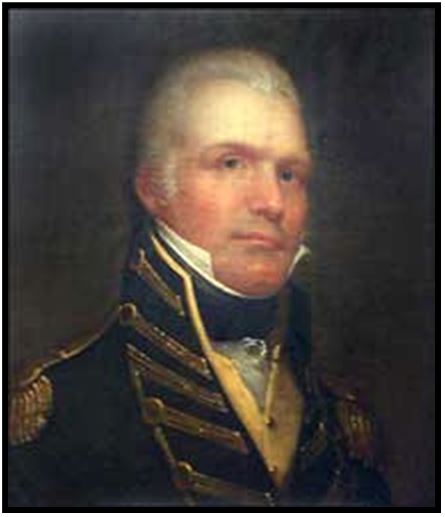
Things did not always go that well for the American fleet.  On October 31, 1804, the USS Philadelphia ran aground in Tripoli Harbor and was captured by the harbor’s defenders. It’s captain, William Bainbridge, and all of his crew were made slaves.

Captain William Bainbridge

Four months later, Lieutenant Stephen Decatur, and a contingent of U.S. Marines captured a Tripolitan ship, stormed the Philadelphia – which was being used as a gun emplacement against the American fleet – and set it on fire, destroying it.

In spite of the treaty Joel Barlow helped put in place which released 115 Americans from Algerian slavery, in spite of the victory of the Enterprise, and the attacks on Tripoli, the Barbary Pirates were not defeated.

William Eaton was the American consul in Tunis, and he was increasingly frustrated by the inability of America to free itself of the Barbary Pirates.  He devised a plan to replace Yusuf Karamanli with his exiled brother, Hamid.  He convinced President Jefferson to give him money and Marines and the command to raise an army.  Jefferson told the American commander in the area, Commodore Samuel Baron to assist in the plan.

William Eaton

Baron reluctantly gave Eaton $20,000 for the operation, but instead of releasing 200 Marines to serve with Eaton – who although he did not have the rank, insisted on being called “General” – instead giving him only 8 men.  He did direct Lt. Presley O’Bannon to command the Marines in the operation – and that choice was vital for the success of the operation. 

Lt. Presley O’Bannon

Eaton recruited 500 Arab and Greek mercenaries, and they sat out from Alexandria for Derne.  Along the way there were at least two attempts at desertion by the mercenaries who were encouraged to stay with the force by O’Bannon and the Marines.  Hamid Karamanli attempted to sneak out one night and return to Alexandria, but Eaton convinced him their plan would work.

After a 50 day march, Eaton’s forces reached Derne.  Coordinating with American ships in the harbor, Lt. O’Bannon and the Marines, together with the mercenaries, attacked the fort. Within 75 minutes, Derne had fallen to the Americans.  Some two dozen of the mercenaries were killed.  Not a single Marine was lost.

Yusuf Karamanli tried to rally his troops and retake the city, but on June 10, 1805, he signed a treaty with the United States, ending the hostilities.

Francis Scott Key composed a patriotic song to mark the occasion.  You will immediately recognize the tune, but it is not the song that will come to your mind when you hear the music.

That song has been all but lost to history. But brushed up and revised a little for the War of 1812, and set to the same music, it has enjoyed considerable success since. 

So has the Marine Corps anthem, which begins: “From the halls of Montezuma to the shores of Tripoli.” 

The Tripoli Monument, the oldest military monument in the U.S., honors the heroes of the First Barbary War. Originally known as the Naval Monument, it was carved in Italy in 1806 and brought to the U.S. on board the USS Constitution. From its original location in the Washington Navy Yard, it was moved to the west terrace of the national Capitol and finally, in 1860, to the U.S. Naval Academy in Annapolis, Maryland.

The Tripoli Monument

In 1812, the United States and Great Britain went to war again and the Dey of Algiers took advantage of the situation, seizing several ships.  

In 1815, when the Treaty of Ghent ended the War of 1812, President James Madison deployed men and warships against Algiers, beginning the Second Barbary War.

When the American squadron, commanded by Stephen Decatur arrived at Algiers, having taken two of Algiers’ prize ships, and 500 sailors prisoner, the Dey asked for terms.  A second squadron under William Bainbridge was further proof to the Barbary States that they had chosen a wise course.

The era of the Barbary Pirates finally ended in 1830 when France occupied Algiers and took control of the Barbary Coast.

👉  Today’s close is from the Smithsonian Magazine:

On a rainy September 13, 1814, British warships sent a downpour of shells and rockets onto Fort McHenry in Baltimore Harbor, relentlessly pounding the American fort for 25 hours. The bombardment, known as the Battle of Baltimore, came only weeks after the British had attacked Washington, D.C., burning the Capitol, the Treasury, and the President’s house. It was another chapter in the ongoing War of 1812.

A week earlier, Francis Scott Key, a 35-year-old American lawyer, had boarded the flagship of the British fleet on the Chesapeake Bay in hopes of persuading the British to release a friend who had recently been arrested. Key’s tactics were successful, but because he and his companions had gained knowledge of the impending attack on Baltimore, the British did not let them go. They allowed the Americans to return to their own vessel but continued guarding them. Under their scrutiny, Key watched on September 13 as the barrage of Fort McHenry began eight miles away.

“It seemed as though mother earth had opened and was vomiting shot and shell in a sheet of fire and brimstone,” Key wrote later. When darkness arrived, Key saw only red erupting in the night sky. Given the scale of the attack, he was certain the British would win. The hours passed slowly, but in the clearing smoke of “the dawn’s early light” on September 14, he saw the American flag – not the British Union Jack – flying over the fort, announcing an American victory.

Key put his thoughts on paper while still on board the ship, setting his words to the tune of a popular English song. His brother-in-law, commander of a militia at Fort McHenry, read Key’s work and had it distributed under the name “Defence of Fort M’Henry.” The Baltimore Patriot newspaper soon printed it, and within weeks, Key’s poem, now called “The Star-Spangled Banner,” appeared in print across the country, immortalizing his words – and forever naming the flag it celebrated.

Nearly two centuries later, the flag that inspired Key still survives, though fragile and worn by the years. To preserve this American icon, experts at the National Museum of American History recently completed an eight-year conservation treatment with funds from Polo Ralph Lauren, The Pew Charitable Trusts and the U.S. Congress. 

-30-